Posts

Can ghosts shape our selves?

Image
Ghosts serve perhaps a useful role in human lives: they could help define the nature of our selves and what it is to be human. I discuss this in this essay which was published on 29 August 2023 by Blue Labyrinths magazine. See  https://bluelabyrinths.com/2023/08/28/can-ghosts-shape-our-selves/   Hamlet and his father (William Blake, 1806) (Public Domain)

Book Review: Metazoa

Image
My review of Peter Godfrey-Smith's book, Metazoa: Animal Minds and the Birth of Consciousnes s has just been published in the Newtown Review of Books . (Image: Pleine Mer, Pierre Bonnard (1867-1947) (Wikimedia Commons))

Not all art is beautiful (and that’s good)

Image
Is aesthetics only about art that is beautiful as conventionally understood? If not, what purpose does art that may not be so serve? My new essay published in May 2022 in Blue Labyrinths        Image: John Constable, Hadleigh Castle (1837) (Public Domain)

Views of Reality from Stagecraft, Science, and ‘Nowhere’

Image
Robert Delauney, Eiffel Tower (1911) (Public Domain, via Wikimedia Commons) There are numerous ways in which the fourth wall can be transgressed. Then what is the role of the fourth wall as an inviolable boundary between fiction and reality? Secondly, is evidence of such infringements today a sign that society is becoming more self-reflexive in a quest to redefine the borders between fiction and the “real” world?                                                                                                             My new essay published in the July 2021 issue of Epoche Magazine

Can Pascal’s rationality rescue the pandemic vaccine?: My second essay in Blue Labyrinths

Image
How do you convince someone to take the coronavirus vaccine? This essay argues that we can do so by presenting to them a reasoned argument from theology, namely, Pascal's wager. See essay at  https://bluelabyrinths.com/2021/04/25/can-pascals-rationality-rescue-the-pandemic-vaccine/ The Triumph of Death (1532) by Pieter Brueghel the Elder, Public domain, via Wikimedia Commons

Art, temporality and the "motions of the mind": My essay published in Blue Labyrinths

Image
 It is a commonplace to claim that art imitates life. If so, art, in performing this mimesis, should respond also to our obsession and concern with temporality (time as experienced, not as measured, or human time as opposed to what the metaphysicians claim). How does art participate in this alchemy of smelting clock time into felt time? Read essay at Blue Labyrinths .

Another research paper published on Jorge Luis Borges

Image
  My research paper on “Time and the Observer in Jorge Luis Borges” has been published in the 2020 edition of the Literature & Aesthetics journal released a few days back. Abstract: Jorge Luis Borges is ambivalent in his views of time and is unwilling to completely accept a denial of the reality of time. I argue that this is because a view that refutes time denies the observer too along with it.  Borges tries therefore to identify a reconciliation between a refutation of time and its reality.  (Image: Edwaert Collier - Vanitas Still Life with a Statuette of an Antique Athlete and a Print of Michelangelo (1675) - Public Domain)

Publication of Guest Post #2 in Aesthetics Research Lab

Image
My essay Aesthetic ineffability and the rebirth of the reader  was published in May 2020 on  Aesthetics Research Lab ,  a "digital think tank and resource, revolving around theoretical and practical issues in aesthetics" conceived by Michael Spicher, PhD.  Here is the  link . This essay examine the idea that literature is as capable of giving rise to an experience of aesthetic ineffability as the other arts. Furthermore, the ineffable experience in literature may be a product of both the author and the reader, and that there is similarly a need for a confluence between the artist and viewer in other art forms too for ineffability to arise.

Publication of my second essay in The Punch Magazine

Image
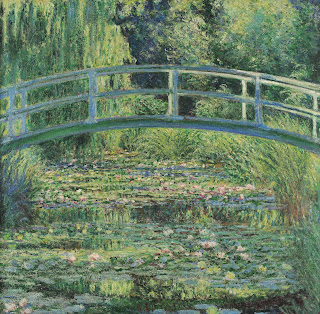
My essay  Vasily Grossman, Graham Greene and the nature of doubt  was published in  The Punch Magazine  in May 2020 - see  link. Claude Monet, Water Lily Pond (1899) (Wikimedia, Public Domain) What’s more important: having faith or being human? This essay examines this question by juxtaposing the work of the Russian writer Vasily Grossman against that of the English novelist Graham Greene.

Publication of my Guest Post on Aesthetics Research Lab

Image
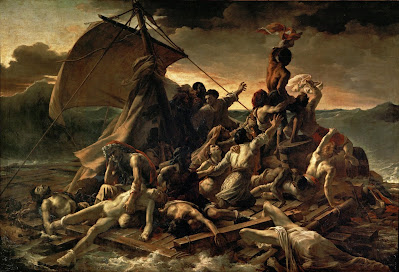
My essay Vivaldi for Gorillas: Seeking Aesthetics in Adversity was published in March 2020 on  Aesthetics Research Lab ,  a "digital think tank and resource, revolving around theoretical and practical issues in aesthetics" conceived by Michael Spicher, PhD.  Here is the link . In this essay, I discuss this question: Why does someone reach for beauty in circumstances of adversity when it is usually presumed that staying alive presupposes all else? Théodore Géricault, The Raft of the Medusa (1819) / Public domain (Wikimedia Commons)

Publication of my essay in The Punch Magazine

Image
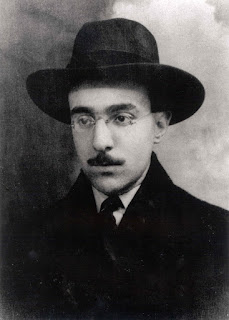
My essay  The Exile of Pessoa & Camus  was published in  The Punch Magazine  in May 2019 - and here is the  link. Poet and philosopher Fernando Pessoa (1888-1935) describes himself as someone who is an “exile from the country of which he had always considered himself a citizen…” Is it apposite to associate exile with someone who — apart from spending nine years in South Africa during his youth — essentially never stirred out of his native Portugal? This essay examines this question by comparing Pessoa to another famous exile, Albert Camus.

Publication of my research paper on "Literature and the construction of reality"

Image
My research paper on “Literature and the construction of reality” has been published in the 2018 edition of the Literature & Aesthetics Journal released in March. Peregrine falcons (Artwork: NY State Museum 1912, Public Domain) In this paper, I consider the idea that Ernst von Glasersfeld’s “radical constructivism” offers an ideal framework for putting in place a reality of the best fit for us. Along with this, I examine also the fundamental biological and epistemological limitations that we are faced with when trying to fathom objective reality and, secondly, the inescapable gap between language – which we use as a primary cognitive tool in our attempt to comprehend the world. The paper then show that literature – especially fiction – best meets the criteria for addressing these gaps and constructing such a model of reality in line with what radical constructivism proposes.

Publication of my essay in Epoche Magazine

Image
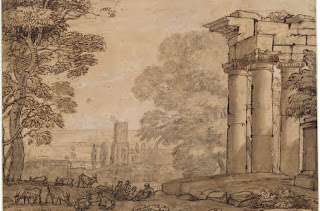
My essay titled A disdain for the discrete: How art transcends logic and language published in the March 2018 issue of  Epoché Magazine - and here is the link . Claude Lorrain, Landscape with Ruins, 1650 (NGA, Washington DC) In this essay I argue that art is able to open a new window on to reality only when art can transcend reason and the confines of language. I contend further that both logic and language have their limitations when used as tools for the creation of meaning and that art helps us overcome these inadequacies in the way it transcends — or even transgresses — the absolutes that underpin our “rational” view of the world. I believe too that the violation of the strictures of logic by art is also emblematic of art’s heightened awareness of certain unique features of reality — in particular, its dynamic and fluid nature — which are not normally readily visible to a mind tied to thinking in terms only of binary truth values.

My published research paper on Jorge Luis Borges

Image
Jorge Luis Borges, 1968 (Credit: Wikimedia Commons) My research paper on “Jorge Luis Borges and the Nothingness of the Self” has been published in the 2016 edition of the Literature & Aesthetics journal released a few days back. In this paper, I discuss how Borges uses his ideas on selfhood to explore the “central problem of literature” that Andre Maurois highlighted and how in the process projects to the reader his idea of reality. I argue also that the self that Borges tries to present in his work may nevertheless not be always congruent with the self he may have wanted to convey. This is because his quest is influenced by a number of factors, not least the fact that the self-creation process is affected by our interplay with the external world.

Human is: What Steinbeck and Levi have to say

Image
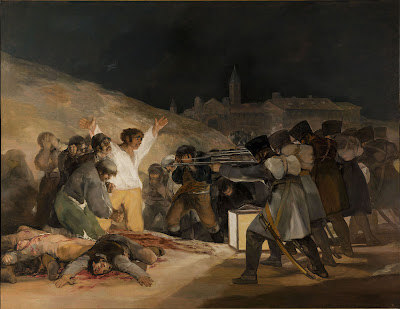
The courage that Steinbeck writes about is one of physical and moral bravery whereas the strength of character Levi portrays should properly be termed “spiritual” or “existential” valour. The Third of May 1808 , Francisco de Goya 1814 (Public Domain, Wikimedia Commons) e seem of late to be more and more concerned with the question of what makes us human. Perhaps this has to do with the rise of secularism or our angst about machines. But it would seem humans have mulled over this question for a lot longer than we realise (even if not with the same intensity). Aristotle for instance thought that reason was what was so unique about us. We were not only the only species to have the ability to exercise our intellect but are conscious that it is also morally good to do so. In more recent times, the historian   Yuval Noah Harari has steered clear  of reason and morality while holding that what is special about humans is the fact that they are the only animals who can ...

Books that have shaped me

below is the list (not in any order) of my book suggestions that we referred to in another post. This lists some books that have shaped my view of the world (especially philosophy of mind and AI). I do not, naturally, expect everyone to agree with what I have chosen. I am nevertheless listing it via a separate post in case others are interested/curious. Included in this list are some works of fiction which may be a surprise to some. However, an understanding of science and art is never complete without literature’s weltanschauung. ("I don't paint what I see, I paint what I know." Picasso) No Genre Author Book Title My thoughts Joseph Campbell The Power of Myth Joseph Campbell The Myths We Live By Philosophy/Cognitive Science Douglas Hofstadter & Daniel C Dennett (eds) Mind's I: Fantasies and Reflections on Self and Soul Dougl...